Showing posts with label publications and studies. Show all posts

Locals vs. Tourists!

, , | 0 comments

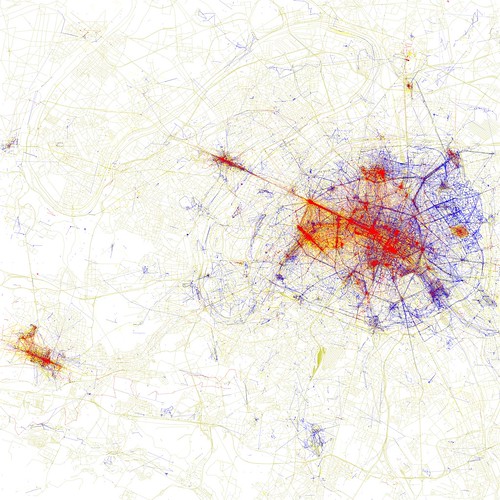
A very interesting study by Eric Fisher (link to the flickr album here) maps out visually an aggregation of snapshots to locations where tourists take pictures and where locals take pictures. Tourist "zones" come out as red hotspots whereas locals are transcribed in blue. There are several cities in the collection to take a look at, both in Europe, US and around the world.

Epcot and Disneyworld in Orlando is also part of the collection, curiously. It is not a surprise that Rio de Janeiro's hotspots tend to be concentrated littorally, rather than in the mountain areas that are where many of the favelas are located. I was curious to see if the famous Rocinha favela might be in red, since it is where most of the "slum tours" are run, but it isn't labelled on the map. Rome and Las Vegas are apparently completely overrun by tourists, with hardly any blue sections, while less popular destinations such as Milwaukee only have isolated red dots. I would have liked to see some cities from Africa or South Asia represented.

WASHINGTON, DC


PARIS


2010 Global Peace Index

, | 0 comments

The 2010 Global Peace Index by Vision of Humanity is out, which surveyed 149 countries according to 23 indicators: perceived criminality in society, security officers and police, number of homicides, jailed population, access to weapons, level of organized conflict, violent demonstrations, level of violent crime, political instability, respect for human rights, weapons imports, potential for terrorist acts, deaths from conflict (internal), military expenditure, armed services personnel, UN peacekeeping funding, number of heavy weapons, weapons exports, military capability/sophistication, number of displaced people, neighboring country relations, number of conflicts fought, deaths from conflicts (external).


Seems that these indicators might provide for a bit of conflation between countries that often serve and provide resources as external peacekeepers and those that suffer from internal conflict, however it is an important study and an excellent resource. Some of the findings include the following:

Top ten countries (respectively): New Zealand, Iceland, Japan, Austria, Norway, Ireland, Denmark, Luxemburg, Finland, Sweden,

Bottom ten countries (respectively): Iraq, Somalia, Afghanistan, Sudan, Pakistan, Israel (Palestine not mentioned), Russia, Georgia, Chad, DRC

Top five risers: Ethiopia, Mauritania, Hungary, Lebanon, Haiti (which I assume is pre-earthquake)

Top 5 fallers: Cyprus, Russia, Philippines, Georgia, and Syria

The most peaceful countries had characteristics of:

• Well functioning government
• Sound business environment
• Respectful of human rights and tolerance
• Good relations with neighbouring states
• High levels of freedom of information
• Acceptance of others
• High participation rates in primary and secondary
education
• Low levels of corruption
• Equitable sharing of resources.

Overall, the World has decreased in its peace (although the United States has increased from 2007 to 2010), with 62% of the countries surveyed worsening in their GPI score. The only regions to increase on average were the Middle East and North Africa and Sub-Saharan Africa.

From the GCC, Qatar ranks highest at 15/149, followed by Oman at 23rd place and Kuwait at 39th spot. It shouldn't come as a surprise that Saudi Arabia ranks lowest at 107th place, not far from its neighbor Yemen at 129th. The only GCC countries to increase in their GPI since 2007 were Kuwait and Qatar.

Ever-increasingly xenophobic and evermore in economic crisis Europe, particularly many of the "Alliance of Civilizations" countries did not fair so much better in its improvements. Spain dropped from 21st place in 2007 to 25th in 2010, Italy from 33rd to 40th, Switzerland from 14th to 18th, Greece from 44th to 62nd, Turkey from 92nd to 126th (putting it in red), Germany from 12th to 16, although the United Kingdom (49 to 34) and France both improved (34 to 32). The Balkan countries also saw an increase in GPI.

For the full view of the country map, click here


Local Coverage of Human Rights Watch Report Omits HRW's Focus on LGBT Issues Brought Up in Report

, | 0 comments

Just after reading an article by The Kuwait Times entitled "HRW Slams Treatment of Labourers, Bedoons", I am realizing that they have neglected the fact that the report also spoke of the countless harassment and discrimination against the LGBT community!

Human Rights Watch 2010 World Report Now Available

, , | 0 comments

You may access the pdf version of the entire report, which gives a summary of the status of human rights in each country, by clicking here. Regarding Kuwait in particular, here are some highlights of the findings:


-Kuwait has made improvements in women's political rights, particularly with the election of four women in Parliament, although women still face significant discrimination in all aspects of daily life. These legal forms of discrimination include: the right to pass on nationality to children, access to low-interest housing loans, and divorce settlements. Perpetrators who commit violence against women are rarely arrested.

-Kuwait hosts several stateless people, known as Bidoun, who amount to around 120,000 of the population in Kuwait. A 2007 draft law would grant the Bidun civil rights, but not nationality, although this has not yet passed. Children of Bidoun are also exempt from being able to have any eligibility for nationality. The Bidoun face several travel restrictions, legal loopholes and civil rights discrimination limiting their access to services and employment.

-Kuwait freedom of expression in the media is often thwarted by fines and bans for slandering the government. In one case in October 2009, two Kuwaiti members of parliament were fined for criticizing the Interior Ministry's treatment of the Bidoun.

-Kuwait continues to discriminate against the gay, lesbian and transgender community. Homosexual conduct is a criminal act in Kuwait under Article 193 of Kuwait's penal code. Men who engage in consensual sexual intercourse between men over age 21 are sentenced for up to seven years imprisonment. If the conduct involves persons under the age of 21, the sentence is increased to 10 years. Transgender people are often sent to prison or fined for "imitating the appearance of a member of the opposite sex." They are also subject to harassment.

-About 80% of the country is comprised of expatriots, many of whom face high residency fees leading to unpayable debt, and whose rights are not adequately covered by the existing labor law. Due to the abuse of several domestic workers and unskilled labor, several embassies have placed bans on the entrance of their citizens to Kuwait for employment. The source of the problem lies in the current sponsorship system (kafala), which trap workers in averse situations and keeps abusive sponsors out of the gamma of law enforcement.


Forbes Friendliest Countries: Bahrain Number 1

, | 0 comments

Forbes conducted a survey study of the "world's friendliest countries" using indicators: 1) making friends 2) making local friends 3) joining community groups 4) organizing school for my children 5) organizing my finances 6) organizing my health care 7) finding somewhere to live 8) setting up utilities. Bahrain came out number one, and was strongest on making local friends. Spain also came out on the list at number 9, and oddly enough United States came next, ranking highest on organizing my health care. Hat tip to SOME Contrast. I am dying to know where Kuwait ranks, but I can't access the full story.

The rankings are as follows:

RankCountry12345678
1Bahrain520153124
2Canada112367852
3Australia1069717115
4Thailand11618411219
5Malaysia41419133413
6South Africa6283146314
7Hong Kong31712172583
8Singapore718241364131
9Spain128131810978
10United States1574122024107


Arab Knowledge Report 2009 Now Available

, , | 0 comments

A report by through joint sponsorship and support of the Mohammed bin Rashid Al Maktoum Foundation (MBRF) and the United Nations Development Programme/ Regional Bureau for Arab States (UNDP/RBAS) aimed at:

The Arab Knowledge Report 2009 examines the current state of Arab knowledge. It derives its legitimacy from the pressing need for information about knowledge performance in the region at a time when the importance of knowledge for the realisation of the many new prospects it has opened up for all areas of society is increasing
Still a bit confused? So am I, and I have not read it yet, join me in reading it here.

2009 Global Corruption Report by Transparency International Now Available

, , | 0 comments

I would like to obtain a copy of this, as the theme for this year is Corruption and the Private Sector, and I am quite curious as to what has been found for the Gulf region, but it does not seem available by download from the website. However, I am including here some information about the theme for this year's report:

Transparency International’s Global Corruption Report 2009 (GCR09) brings together leading scholars, business practitioners and civil society experts to examine a broad range of persistent and emerging corruption risks for business, assess the efficacy of existing remedies, and propose
practical and innovative measures to strengthen and future-proof corporate integrity.

Topics covered include:

  • Corruption inside the enterprise: responding to
    corporate fraud and conflicts of interest.
  • Needs-tailored strategies: addressing corruption risks in SMEs, high-risk industries and privatisation programmes.
  • The state of play in compliance, reporting, codes and regulation: what works, what doesn’t,
    what’s next?
  • Holistic corporate integrity – aligning values, incentives and market signals: engaging owners,
    lenders and gatekeepers.
  • New and emerging markets: compliance in a changing global economy.

How Many Hours Punched Does it Take to Afford a Big Mac?

, , | 0 comments

The Economist has published an blog entry entitled "An Alternative Big Mac Index" about a UBS study that looks how how many hours on average people in a city have to work to afford a Big Mac. This goes a little bit further than the purchasing power Big Mac index.


THE size of your pay packet may be important, but so is its purchasing power. Helpfully, a UBS report published this week offers a handy guide to how long it takes a worker on the average net wage to earn the price of a Big Mac in 73 cities. Fast-food junkies are best off in Chicago, Toronto and Tokyo, where it takes a mere 12 minutes at work to afford a Big Mac. By contrast, employees must toil for over two hours to earn enough for a burger fix in Mexico City, Jakarta and Nairobi.

The Economics of Happiness in the Middle East

, , | 2 comments

One of my former professors, Dr. Carol Graham of the Brookings Institution, first introduced me to the concept of quantifying happiness through surveys as a an indicator of a country's development. In short, as much as GDP or PPP per capita, infant mortality rates or literacy might be able to be used as a measure in the end all that really matters is whether Country X is happy or not, no?


Well mixing philosophy and economics to better understand the psychology of a people provides for some interesting and unexpected country rankings for sure, and material wealth and happiness do not necessarily have a positive correlation. Some studies that look more deeply into how people "feel" in order to add breadth to traditional development economics hard statistical data include the World Values Survey, The Satisfaction with Life Index, and now the Happy Planet Index.

The HPI combines happiness (a simple 1 to 10 scale) with sustainable living, as measured by the ecological footprint. We use ecological resources (and no one knows this better than Kuwait) as a means to achieve "long, happy, fulfilling lives". The HPI is an index of "happy life years" (life satisfaction multiplied by life expectancy) per unit of the ecological footprint.

The justification for this? According to research designers, "we should not lose sight of the fact that economic growth is just one strategy to achieve well-being, and in terms of natural resources, a demonstrably inefficient one. Rather than pursuing growth at all costs, even if detrimental to well-being and sustainability, leaders should be striving to pursue well being and sustainability, even if detrimental to growth."

I like this philosophy, and I believe this kind of measure puts much of the material happiness from oil revenues in this region more in check, where happiness would be otherwise severely inflated in the Gulf region. Here, happiness has cleverly been linked to sustainability and progress of societies can be reflected in their relationship to the environment.

Amazingly, Latin America with all its problems of debt, inflation, inequality, crime, violence, corruption and political instability surpassed OECD countries on the HPI index. They attribute this high ranking of the region to its unmaterialistic values and aspirations, as well as strong social capital through civil society. The top ten rankings are as follows (assuming an 89.0 HPI target for 2050):

1. Costa Rica (76.1)
2. Dominican Republic (71.8)
3. Jamaica (70.1)
4. Guatemala (68.4)
5. Vietnam (66.5)
6. Colombia (66.1)
7. Cuba (65.7)
8. El Salvador (61.5)
9. Brazil (61.0)
10. Honduras (61.0)

How does the Middle East fair? Here are the rankings for the region:

13. Saudi Arabia (59.7)
26. Jordan (54.6)
38. Syria (51.3)
50. Yemen (48.1)
56. Palestine (47.7)
67. Israel (44.5)
79. Iraq (42.6)
81. Iran (42.1)
83. Turkey (41.7)
110. Lebanon (33.6)
111. United Arab Emirates (28.2)
128. Kuwait (27.0)

Interestingly enough between UAE and Kuwait and after Kuwait until the final ranking are all Sub-Saharan African countries, meaning that UAE and Kuwait are not much happier than SSA in terms of well-being taking into account sustainability. Perhaps most curious is the fact that Luxembourg, coming in at 122 on the ranking, is sandwiched between Sudan and UAE. United States ranks relatively low at 114. What accounts for the major gap between Saudi Arabia, which comes up incredibly high on the HPI and Kuwait, which takes the lowest place for the Middle East?