Showing posts with label spain. Show all posts

Flamenco and Kathak

, , | 0 comments

I went to my first flamenco show since I arrived in Spain, called "Algo más que flamenco", playing at El Teatro Arlequín. The spectacle is meant to showcase the different regional dances of Spain, focusing on flamenco primarily but also giving us glimpses of the Zarzuela, Muñeira, Aurresku, etc.


While watching the dancers I couldn´t help be reminded to Indian Kathak dance. Some of the turns, hand movements and the use of feet for rythym are so strikingly similiar. Actually, flamenco has Indian origins as the gypsies, or Rom people, are said to have originated from what is now Rajasthan. Of course, then flamenco received a melting pot of influences from all the different cultures that inhabited Spain. Speaking of which, today Madrid´s summer event series "verano en la calle" had a group called Musafir, gitanos de Rajasthan that played in the park. Sad I missed it. Here you have some clips of Flamenco and Kathak. I love the last video in particular.

COUPLES FLAMENCO VERSUS KATHAK


GYPSY DANCE YOUNG BOY SINGING-WOMAN DANCING


World Cup Final Interpreted by Legomen

, | 0 comments


Madrid Wants Paul, according to The Guardian

, , , | 0 comments


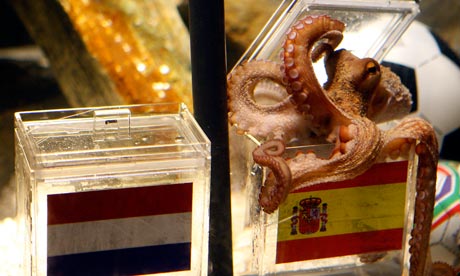
Paul the octopus set for sensational transfer to Madrid aquarium

Spanish zoo prepared to meet 'any demands' to sign German cephalopod that predicted team's World Cup final victory

In what may prove to be the biggest transfer story this summer, negotiations have begun to bring Paul the psychic octopus to Madrid after he correctly predicted Spain's World Cup final victory.

Madrid's Zoo Aquarium says it is prepared to trump any other offer Germany's Oberhausen Sea Life Centre receives for Paul, certain that the world's most famous cephalopod will attract thousands of visitors.

At present no cash is on the table, and the zoo says it is trying to negotiate an exchange of animals.

Sounding more like the president of Real Madrid than a zookeeper, a spokesman said he was confident that Paul would be in Madrid within a few days. Madrid was prepared to offer Oberhausen "whatever they demand" to complete the deal — suggesting that this will be a cash-plus-animal transfer.

He added that Paul, named after a German children's book by Boy Lornsen, would be treated "with tender loving care" because of his national treasure status in Spain.

Paul correctly predicted the outcome of all seven of Germany's World Cup matches, as well as the final between Spain and Holland. This was an improvement on his record for the 2008 Eurocopa, in which he correctly predicted four out of six of Germany's games.

During the World Cup, Paul became a media phenomenon, with his final predictions screened live on television. He also became the world's third most popular Twitter trend during the competition, out-doing both Shakira and Cristiano Ronaldo with 141 hours of trending.

A Brazilian company has developed an iPhone app based on Paul's performance, allowing users to consult the octopus to help them make decisions. The Ask the Octopus app lets users ask 50-50 questions, to which a cartoon of Paul chooses an answer.

(for link, click here)

Pulpo Paul

, , , | 0 comments

Being in Madrid has been exhilarating these past days, to say the least. The one thing that has been the most enjoyable has been seeing the hysteria of veneration for Paul "The Oracle" Octopus, known in Spain as "Pulpo Paul". Cow is to India what Octopus is to Spain now.

The Guardian: "World Cup 2010: Spain's success puts nationalists in the shade"

, | 0 comments

For full article, click here:

They call it "the red effect". It has spread down Spanish streets on the torsos of hundreds of thousands of fans wearing the shirt of the national soccer team, La Roja or "The Red", and threatens to over-run even the most obdurately separatist corners of the country. On nights when the team notches up another World Cup victory it turns into a musical chant: "I am Spanish! Spanish! Spanish!" they shout joyfully. "I am Spanish! Spanish! Spanish!"

Spaniards cannot recall an outpouring of national pride similar to that provoked by the country's first-ever appearance in the World Cup final today. "Not since the Spanish civil war have there been so many flags in the streets," El País newspaper reported as Madrid prepared for an all-night party if La Roja beat Holland in South Africa this evening.

Indeed, Spain's red and gold flag still reminds some people of the civil war of the 1930s, more particularly, of the 36-year dictatorship of Francisco Franco, leader of the pro-fascist Nationalists, that followed it. Few countries in Europe, except Germany, have such an instinctive mistrust of patriotism.

Such an outpouring of national pride also raises challenging questions about Spain's vision of itself. This is a "nation of nations" according to some, who see Catalonia and the Basque country as unrecognised nations which, like Scotland, deserve their own football teams. Spain oppresses other nations, according to separatists, including to the Basque terror group Eta – which exacts its revenge in blood. The country's constitutional court disagrees. "Our constitution recognises no nation but Spain," it affirmed on Friday in a stern rebuke to Catalans who hoped a new autonomy statute might formally allow them to be known as a nation within Spain.

Spain Sets Eyes on Kuwait Metro Project

, , , , , | 0 comments

The blog re:kuwait has written signficantly about the Kuwait Metro Project, a topic that picked up steam after the inauguration of the Dubai Metro system in the UAE rival city last year. Al-Watan Daily is reporting that Spanish companies show keen interest in the project (the design of the metro plan itself was done by a Spanish firm). The metro network would be part of an overall GCC railway linkage project. A Spanish-language report by INESCO TIFSA dating back to October 2007 also details the project. You can read it by click on this link.

Book: Leaving Tangier by Tahar Ben Jelloun

, , , | 0 comments

Picked this book up at the Virgin Store in the Beirut airport while I was waiting for a connection flight. It is an easy read and I got through the entire book on my long flight.


It deals with a brother and sister who emigrate from Morocco to Barcelona. The brother basically catches the eye of a gay Spaniard named Miguel who goes to Morocco often for leisure and business. He creates a pseudo-job for the brother, who I think is called Azel (?), provided he live with him in Barcelona, be his lover and basically be at his beck and call.

Meanwhile, the brother convinces Miguel to marry his sister so that she may also come to Spain, which Miguel does, although there are no romantic feelings between the sister and the Spaniard. In the end, what the story highlights on are how different people deal with emigration into a foreign land, who ruins themselves in the process and who paves out opportunities for themselves. I wished that the story had created more dialogue between the three characters to show their interaction in greater depth, but in the end it was a page turner.

Op-Ed Reaction to Khalil Ali Haider: "The Spaniards Do Not Want to Learn Arabic"

, , | 3 comments

As a person teaching Spanish to some of the most diligent, interested Kuwaiti students of the language, I couldn't help but being intrigued by this op-ed. I agree with Mr. Khalil on many points. Spaniards are very lazy at learning languages, and can't seem to be bothered. Arabic, unfortunately, is just another victim to this. More critically, however, the Spaniards don't want to learn English either. Spain has one of the lowest rates of English fluency in the entire European Union. Its really a national embarrassment for me. To be honest with you, before promoting any other second language, English needs to be invested in heavily in Spain to bring the country's citizens to international standards regarding understanding of the English language, perhaps then we can focus on other foreign languages, such as the author writes, Arabic or Chinese.

Spain also has an integration problem. In comparison to other European countries, Spain has only recently had waves of migration into the country, and its immigrant population is still relatively new. How Spain is able to integrate the children of these first-generation citizens, will depend on how well Spain can educate its people on multiculturalism, tolerance for diversity and battling of racism--which is, unfortunately, notoriously horrible in Spain, as many national public embarrassments during several international sporting competitions can attest. For a long time, Spain was an immigrant-exporting country, and the people must never forget this fact in their discussion of integration and migration in the present day.

Now, regarding the promotion of the Arabic language, something that perhaps the promoters could learn from. Spain has what we might call soft or cultural diplomacy, in the form of El Instituto Cervantes, a center for Spanish cultural promotion and language abroad. They have offices all over the world. This is similiar to perhaps the British Council. Why not begin one focused on the Arabic language?

Last month, a Spanish citizen poured icy cold water on the Arab-Spanish cultural relations and at the same time offered it a beautiful rose. On Jan. 1, 2010 Al-Sharq Al-Awsat newspaper reported that the local government in Andalusia Province's latest bill to teach the Arabic language as a second foreign language in educational institutions was met with strong oppositions.

The newspaper's correspondent Subaih Sadiq said that the bill aims at integrating Arab and Roman immigrants into the Spanish society. The concerned committee suggested allocating 25 million euro until 2013 to implement the proposal. The bill suggests teaching Arabic as a second foreign language in the Andalusia Province and urging educational institutions to open Arabic departments. 400 opponents commented on the bill through an electronic newspaper.

Some said that: "Teaching Arabic will not benefit them. The government should encourage studying Spanish instead." Others said: "We have always been studying English and French and now they want to teach us Arabic?" Others said: "There is no doubt that studying languages is important but what is the point of studying Arabic? All those who come to our country should study our language instead of teaching us their language." An extremist said: "I hope that Catholic rulers could be in power to dismiss them again."

Two days later, there were several calls to cancel the Official holiday of Granada on Jan. 2 which was the day when the last Arab kingdom in Andalusia fell in 1492. Granada celebrates the occasion at official and public levels. The Granada Society has announced that it would organize a celebration for dialogue among civilizations and against the fall of Granada as well as to honor the Gypsies, Jews and Arabs who were dismissed from Andalusia.

The Andalusia People's Society issued a statement in which it said: "We want to express our rejection of celebrating the fall of Granada and we call for cancelling this celebration and to replace it by June 26 as the National Day of Granada, which was the day when Maryana Beneida (1804-1831) was executed. Maryana was known for her opposition to oppression and autocracy in Madrid. (Al-Sharq Al-Awsat 3/1/2010).

If there was a proposal to teach the Chinese language in Spain, would the responses of Spanish authorities be the same? I don't know. Many schools in the US, and perhaps in Europe, encourage teaching Arabic. It is said that the annual salary of a translator working for the US forces in Iraq and Afghanistan is more than 180,000 US dollars. In the past we used to fear the Europeans who studied Arabic. Nowadays, the new generations in Europe have no interest in learning Arabic.
(link here)
Good Song and Definately Amazing Bicycle Skills

, | 0 comments