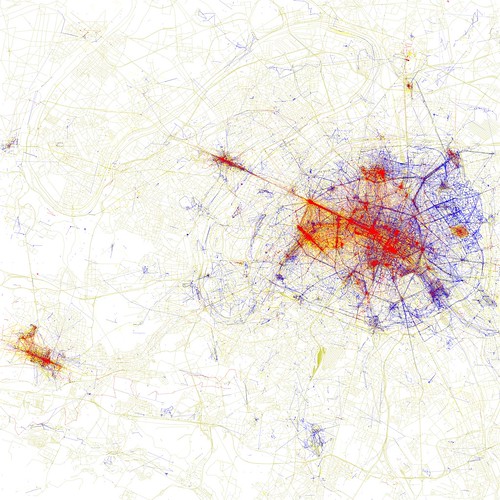
Locals vs. Tourists!


maps, publications and studies, tourism 7:33 PM | 0 comments


esc rights, fair trade, madrid events 9:37 PM | 0 comments
CaixaForum Madrid will be hosting an exhibition on free trade entitled "Comercio Justo. un producto, una historia" until August 28th. It will be accompanied by some interesting film screenings of related documentaries. Each starts at 7 pm. I am accompanying each with a link to its trailer. You can read the official press release, in Spanish, here.
22 de junio, China blue
El comercio justo:
El comercio justo beneficia tanto a productores como a consumidores. A los pequeños productores de zonas empobrecidas, les ofrece la posibilidad de vivir dignamente de su trabajo. A los consumidores, les proporciona productos de calidad y la garantía del respeto a los derechos de los trabajadores y al medio ambiente. Comercio justo significa:
- Salarios y condiciones de trabajo dignos.
- Igualdad entre hombres y mujeres.
- Ausencia de explotación infantil.
- Respeto al medio ambiente y apuesta por la producción ecológica.
- Beneficios destinados a mejoras sociales de las comunidades locales.
El comercio justo apoya a miles de familias campesinas de los países en desarrollo, a la vez que da a conocer al público de los países ricos la realidad, muchas veces desigual, del comercio internacional.
poetry, travels 11:19 PM | 0 comments
"Descent" by Frances Williams
The wing can hold the curve of the earth
Tucked like a pillow under its hard arm.
Australia is passing me her endless
Biscuit prairie, patch scrub trimming off
To curly beach. Peninsulas are sharp
As holly. And then a rash of salt lakes,
A strange pox, turquoise then urine.
At such altitudes, reassurance arrives
In the small white intimacy of plastic
Meals. My cheese cracker is bigger
Than Kangaroo Island. I measure the gap
Between hand and mouth as Melbourne
Fades to Adelaide. Between safety and
Danger, a continent surrenders its widest
Plan. Its dust is the colour of strong char.
Lower, and roads criss cross in grids, run
Straight and true, hold too fast to purpose,
Are thin experiments in meaning. Out through
The bushy tail of history, my travels blow
Sky high. Wherever you go, you're only
Ever you, my mother warned me. But
There again, perhaps she had an interest
In the retardation of the coming new.
The chord at my tail frays in wispy spray,
Slowly dissolves in the long white sun
Which laces the window with its ice.
At Perth the runway beckons as the future
Swiftly rises from the past. Local time
Greets me with a roar, my head held tight
In the playful bite of the world as carnivore.
publications and studies, war and peace 10:57 PM | 0 comments
The 2010 Global Peace Index by Vision of Humanity is out, which surveyed 149 countries according to 23 indicators: perceived criminality in society, security officers and police, number of homicides, jailed population, access to weapons, level of organized conflict, violent demonstrations, level of violent crime, political instability, respect for human rights, weapons imports, potential for terrorist acts, deaths from conflict (internal), military expenditure, armed services personnel, UN peacekeeping funding, number of heavy weapons, weapons exports, military capability/sophistication, number of displaced people, neighboring country relations, number of conflicts fought, deaths from conflicts (external).
arab youth, children, iran, islamic dresscode, saudi arabia, sports 12:45 PM | 0 comments
Some Saudi designers have taken to creating abayas that reflect the flags of the participating countries in the 2010 World Cup. This move, of course, has been met with contraversary, as the colorful abayas are considered inappropriate for the norms of the society. Nonetheless, I believe the issue underscores an important note.
gulf youth, religion in the gulf, saudi arabia 8:18 PM | 0 comments
indian culture, madrid events, movies 8:00 PM | 1 comments
I just got back from Sala Triangulo in Lavapies, a small theatre that is one of the venues for the Imagine India Festival. I went to see Superman of Malegaon by Faiza Ahmed Khan, a documentary about a small village some hundred-something kilometers outside of Mumbai. You would think this would be a normal, textile-industry dominated town, or gaanv, but, like all small villages, there are town personalities and legends at every doorstep. While this sleepy town may be close to the heart of Bollywood, it couldn't be further away from the escapist dreams the industry produces. Malegaon reminds us of another time, a lost Gandhi-era village.

africa, animal rights, dictator antics, news of the weird 9:17 PM | 0 comments
Poor animals, pawns by one megalomaniac dictator to stroke another dictator's ego with an absurdly extravagant gift. Unfortunately many of the animals on-board are endangered species or susceptible to being harmed by the grueling flight and quarantine that would accompany it...not to mention whether the caretakers in North Korea will actually know how to properly care for the animals indigenous to Africa. This article, from The Guardian by David Smith, gives more a more detailed account of the problems that arise from such a half-baked idea.
Conservationists protest as Robert Mugabe sends 'ark' of animals to North Korea
Zimbabwean president sending giraffes, zebras, baby elephants and other wild animals taken from a national park to zoo in communist state, conservation groups say
Two by two, they were caught and lined up as an extravagant gift from one despotic regime to another.
According to conservationists, the Zimbabwean president, Robert Mugabe, will send a modern-day ark – containing pairs of giraffes, zebras, baby elephants and other wild animals taken from a national park – to a zoo in North Korea.
The experts warned that not every creature would survive the journey to be greeted by Mugabe's ally Kim Jong-il, the North Korean leader.
There are particular fears that a pair of 18-month-old elephants could die during the long airlift.
Johnny Rodrigues, the head of the Zimbabwe Conservation Task Force, said elephant experts did not believe the calves would survive the journey separated from their mothers.
Rodrigues, whose task force is an alliance of conservation groups, said all the animals were captured on Mugabe's orders to be given to North Korea. He cited witnesses and officials in the western Hwange National Park. Witnesses reported seeing capture and spotting teams, government vehicles towing cages, and armed men at key watering holes with radios to call in the capture teams.
The animals were being kept in quarantine in holding pens at Umtshibi camp in the park, he said.
Rodrigues added that officials opposed to the captures had leaked details to conservationists.
They reported that some areas of the 5,500 square mile park, the biggest in Zimbabwe, were being closed to tourists and photographic safari groups.
"We fear a pair of endangered rhino in Hwange will also be included," he told the Associated Press.
He said conservation groups were trying to find out from civil aviation authorities when the airlift would begin, and were lobbying for support from international animal welfare groups to stop it.
Zoo conditions in North Korea, which is isolated by most world nations, did not meet international standards, he said. Two rhinos, a male called Zimbo and a female called Zimba, given to Kim by Mugabe in the 80s, died only a few months after their relocation.
At the same time, other rhinos given to Belgrade zoo in the former Yugoslavia died after contracting footrot in damp and snowy winter conditions.
Rodrigues said: "This new exercise has to be stopped. People under orders to do it are too scared to speak out."
North Korea has a long association with Mugabe, and trained a Zimbabwe army brigade responsible for the massacre of at least 20,000 people in the 80s.
Last month Zimbabwe announced that the North Korean football team was bound for a training camp in the country ahead of the World Cup in neighbouring South Africa. Opposition groups pledged to demonstrate against their presence.
Conservation efforts in Zimbabwe have suffered major setbacks in recent years as the country's economy has gone into meltdown. Reports say rhino poaching, driven by Chinese black market demand for the animals' horns, has soared.
Zimbabwe's Parks and Wildlife Management Authority did not respond to requests for comment.
religion, u.s. domestic politics 11:21 AM | 0 comments
I admire this guest for not letting the Fox News reporter depict him as a monster. He would not be pidgeon-holed and, rather, eloquently defended how religious rights are better protected with a secular state. He also called out the reporter on his mix-up of some basic facts.
islamic dresscode, muslims in europe, op-ed reactions, religion in the gulf 10:43 AM | 0 comments
I have been curiously following op-ed articles from Kuwaiti and Spanish newspaper journals to get a greater understanding of the debate on the wearing of the veil in Europe. My time abroad in the Middle East has led me to believe more in "live and let live" than to strict credence of "Liberté, égalité, fraternité" but render to Ceasar...
At an opportune time when civilized nations are seeking to spread the concept of peace and peaceful coexistence with each other, we find some of our own MPs are indulging in projecting a negative image in their dealings with each other. The Ummah Tenets Party''s Secretary General MP Mohammed Hayef had earlier announced a move concerning the stance of the GCC, Arab and Islamic parliaments in initiating action against France. One of the initiatives called for not signing any agreements with France simply because that country went ahead with its ban on the veil. The honorable MP has forgotten an important issue which is that the French measures were taken and applied to enable French citizens to enjoy their religious freedom which the Arabs cannot even dream of guaranteeing in their own countries of origin.
MPs belonging to the political Islamic school of thought know very well that it is better for a man to be a Muslim living in Paris, London and Washington than to be a Christian living in Kuwait, Riyadh or Sudan. Kuwaiti MPs always seem to be the last of the lot where speaking about religious or personal freedoms is concerned. MP Khalid AlـSultan, slammed the French position over wearing veils, and considered it as a downright restriction of personal freedoms while his comrades in Parliament enacted a law in 1980 that bans granting the Kuwaiti citizenship for our fellow Christians. Isn''t such a law a stain on the face of Kuwaiti democracy?
French measures have been initiated for several national and security reasons, mainly involving religion in the daily lives of citizens. France is generally a secular nation which rejects any kind of religious insignia in its schools and official institutions, and this resolution is applied to one and all ـ not just Muslims. The decision was taken purely for security reasons that are in no way related to religion.
Islam in France and other Western countries including the United States spreads rapidly due to the migration of Muslims to these countries in huge numbers. If Muslims, at any given point of time, harbored this feeling that they would be persecuted and unable to practice their religion freely in those counties, why would they leave their countries of origin to live in those countries in the first place?
Frankly, the interference of MPs in the internal issues of France and defending wearing the niqab is not surprising to us at all. It is not surprising despite the fact that niqab has nothing to do with religion as it is a dress code that has spread among the Muslim communities in the Gulf and the Arabian Peninsula and has even moved further to some Arab countries. The Grand Sheikh of AlـAzhar has banned wearing the niqab in AlـAzhar universities while the Egyptian education minister banned it in universities after which Tunisia also followed suit. It is only natural then, that our representatives are required to take action against some of our own Arab countries before going a step further and boycotting France.
madrid events, UN-HABITAT 10:40 AM | 0 comments
Director/a: Justo García Navarro Doctor Arquitecto - UPM; Vocal del Comité Hábitat Español Secretario/a: Ana de Guzmán Báez Arquitecto - UPM; Grupo de investigación sostenibilidad en la construcción y en la industrial Para mayor informacion, aqui06 - Buenas prácticas para mejorar las condiciones de vida. Programa Hábitat de Naciones Unidas
Fecha: Del 05 al 06 de julio de 2010
lebanon, liveable cities, urban history, urbanization fears 10:37 PM | 0 comments
"Beirut is an ugly city."
This statement would infuriate plenty of proud residents of the Lebanese capital, but veteran architect Assem Salaam stands by his words.
He points to the evidence: a jungle of grey concrete that towers over his garden, hiding what used to be a spectacular sea view.
| Assem Salaam Architect |
It is not the loss of the sea view that Mr Salam mourns.
And, he says, it is not the commonplace nostalgia for the old and familiar that drives his bitterness about an extraordinary pace of construction in his city.
"Of course all cities change, but change does not have to be so aggressive and so inhuman," he says.
"Take London, for example. It has changed immensely since I first visited in 1942, but I can still take the same bus route as I did then, or walk the same streets.
"Beirut, on the other hand, has changed beyond recognition," he says.
poetry, Spain and diversity, spanish youth 8:42 PM | 0 comments
Patrocinado por el Instituto Internacional:
built environment, euro-arab cooperation, kuwait, public transportation, spain, urban alternatives 1:46 PM | 0 comments
The blog re:kuwait has written signficantly about the Kuwait Metro Project, a topic that picked up steam after the inauguration of the Dubai Metro system in the UAE rival city last year. Al-Watan Daily is reporting that Spanish companies show keen interest in the project (the design of the metro plan itself was done by a Spanish firm). The metro network would be part of an overall GCC railway linkage project. A Spanish-language report by INESCO TIFSA dating back to October 2007 also details the project. You can read it by click on this link.
citizenship and nationality, kuwaiti politics 1:39 PM | 0 comments
Will the enforcement of income tax improve public services?KUWAIT TIMES POLL
22%
No
77%
racism and discrimination, Spain and diversity, sports 6:29 PM | 0 comments
Coming now into my fourth week of living in Madrid, I have already had the opportunity to watch several football matches in bars around the city, one of which included a Real Madrid game. One of the cultural shocks that I should have known to brace for is the passion Spaniards have for their football, a tradition that is amusing and even endearing...up to a certain point.
Recently, however, I was watching a match in a bar and behind me were to raging individuals against the Real Madrid who kept namecalling Portuguese football superstar Cristiano Ronaldo "gitano", which in English translates to "gypsy". The goal of this blog entry isn't to go into detail on the continued discrimination of the Roma community in Spain, or in Europe for that matter, but rather, the slurs brought my attention once again to the complacency of racist imagery and prejorative words during sports events in Spain.
You can hear it in the bars, like I did. You can see it in the hooliganists' antics on the bleachers as was the case in early 2008 when spectators donned in blackface at the Formula One Grand Prix in Barcelona and taunted British racer Lewis Hamilton with offensive banners and jeers or when they made monkey screeches for French football player Thierry Henry, along with other black players as they was on the field during a friendly game in Madrid in 2004.
You can, however, and most problematically at that, see racism at higher levels of authority-the exact positions who should be the first to dissuage these tense situations instigated by deep rifts of understanding about what constitutes even the thinnest veneer of political correctness.
For example, in 2004 Spanish national soccer coach Luis Aragones called French star Thierry Henry "that black shit" and was subsequently fined by his national federation, although Henry was left offended by the gravity of the retaliation, in the form of a 3,000 euro fine that the agrieved football player found "laughable".
indian culture, madrid events, movies 10:10 PM | 0 comments
From May 18-29, 2010 Madrid will benefit from a cultural festival dealing primarily with film, but including several cultural acts as well. You can see the full programme here and see the official website as well.
poetry, rain in spain series 10:00 AM | 3 comments
Galileo Galilei and me were born on the same day, of the same rock
anecdotes, rants and raves 1:08 PM | 2 comments
Recently, a new blog came to my attention: Kuwait Confession Box. I have to admit I am addicted, and I am glad to see that people are respecting the nature of the blog by writing seriously and not "pranking" the site with false anecdotes.
capital punishment, women's rights 8:16 AM | 0 comments
The arsonist responsible for the Jahra wedding fire has been condemned to hanging, in a ruling presided over by Chancellor Adel Al-Saqer. If so, Nasra Yussef Mohammed Al-Enezi, aged 23, will be the first-ever Kuwaiti woman to be executed.
retro kuwait 6:16 PM | 2 comments
citizenship and nationality 11:52 AM | 0 comments
Should dual nationality holders be stripped of Kuwait citizenship?KUWAIT TIMES POLL
41%
No
58%
rants and raves 11:35 AM | 0 comments
It's really a shame they are so bent on demolishing Old Salmiya. I went today to buy a book in Family Bookshop and let me tell you the variety as well as the price is much better than any mega-store like Virgin.
labor rights in the Gulf 9:03 PM | 0 comments
Gulf states are seeking to buy people’s silence through state hand-outs while unskilled foreign workers are living in conditions “unacceptable to cats and dogs”, according to a leading Bahraini newspaper editor. He added that in Bahrain the average salary in the private sector had dropped by 15 per cent in recent years and more than half the population had been waiting to be housed since 1992.
Dr Mansoor Al-Jamri, co-founder and editor-in-chief of Bahrain’s daily Alwasat newspaper, drew loud applause at Qatar’s BBC televised Doha Debates with his comments.
He said: “The governments have a philosophy based on oil wealth, but instead of letting it trickle down to the people they use it to silence the elite or to by-pass their citizens.”
Speaking of the wretched housing which so many foreign workers from the Indian sub-continent endure in Gulf states, Al-Jamri said they had to live in conditions “that cats and dogs would not accept.”
He warned that if these workers, who make up the vast proportion of unskilled labour, continued to be treated like third class citizens, their inability to share in the decision-making process or have a right of domicile would ultimately lead to the intervention of international bodies in the affairs of Gulf states.
Al-Jamri was speaking at the latest Doha Debate, a unique public debating forum in the Middle East, whose 350-strong audience voted 75 per cent to 25 per cent in favour of a motion that “Gulf Arabs Value Profit over People.”
He told the mainly Arab audience attending the debate, to be broadcast on BBC World News on November 22-23, that token trade unions existed in Bahrain and Kuwait but that they were deprived of powers of collective bargaining and the protection of international labour organisations.
“I am always hearing in the media and from officials how this is not the right time for the participation of the people. They say: we will give you free education and free housing, but just shut up and don’t criticise.”
His colleague on the panel, Dr Najeeb Al-Nauimi, a former Qatari Justice Minister and later lead counsel defending Saddam Hussein in Iraq, condemned governments which summarily deport not just unskilled, foreign labour but teachers and sometimes doctors.
Al-Nauimi decried the lack of compassion towards a labour force which builds extravagant construction projects on meagre salaries with minimal social benefits.
“Oil prices and cheap labour are the basis of our economies,” which depend in turn “on the silence of our citizens,” he said.
Al-Nauimi warned that the Indian sub-continent was forging ahead by opening up its societies to a working, middle and upper class with rights. “We are (just) citizens of the Gulf and represent a marginal class, marginalised by the political process.” (for full article click here)
brazil, indian culture 3:32 PM | 0 comments
This is what happens when a Brazilian soap opera attempts to imitate an Indian drama...A strange lovechild indeed.
book reviews, immigrants, morocco, spain 12:15 PM | 0 comments
Picked this book up at the Virgin Store in the Beirut airport while I was waiting for a connection flight. It is an easy read and I got through the entire book on my long flight.
bahrain, gulf youth, UN-HABITAT, urban alternatives 11:07 PM | 1 comments
Why is this most important? Besides the obvious factors for the Gulf, one of the biggest benefits is that this will give a chance for Gulf Youth to participate and be active. For each World Urban Forum, there is a World Urban Youth Assembly that precedes it. Here is the UN HABITAT press release, closing the 2010 World Urban Forum.
The Fifth Session of the World Urban Forum drew to a close in Rio de Janeiro on Friday with speakers hailing it as the most successful one ever staged.
According to available statistics, some 13,718 participants from 150 countries around the world attended the Session. Secretary of State Mrs. Hilary Clinton of the United States was full of praises for the Forum saying it was a unique venue where people from different backgrounds shared ideas on how to cope with the challenges of urbanization.
Mrs. Clinton who addressed the closing ceremony via a video message said the work of UN-HABITAT in addressing urbanization challenges was crucial adding that there was a greater need to foster private public partnerships in addressing those challenges.
In her speech, UN-HABITAT Executive Director Mrs. Anna Tibaijuka challenged the Forum participants to think long and hard on the kind of future they wanted to leave behind for the generations to come.
“How will our world look in just two generations to come when it is projected that 70 percent of humanity will be living in towns and cities? What percentage will continue to live in abject poverty? How much dirtier will cities make our planet? As we also learned this week, the means to bridge the urban divide are not lacking. We must, however, muster the political will to make our cities fit for our children, and the time to act is now!,” she said.
Mrs. Tibaijuka who leaves UN-HABITAT later this year at the end of a her second term at the helm, said she was walking away with her head high having managed to give the agency a footing, as requested of her by the former UN Secretary General Mr. Kofi Annan when he first appointed her to the post.
In his address, Brazil’s Minister for Cities Mr. Marcio Fortes said the success of the meeting could be gauged in the fact that most of the time, the meeting rooms were turning away some participants because of being fully packed.
During the occasion, the government of Bahrain, the hosts of the Sixth Session of the World Urban Forum in 2012, gave a presentation highlighting what delegates at the meeting are to be offered.
poetry, the staring night series 10:54 PM | 0 comments
music, travels 10:38 PM | 2 comments
Hi everyone, sorry for the long winter of silence, but I have been around the Middle East, and in an undisclosed country in South America, yes its true. I have a big announcement to make soon, in seven days. In the meantime, I just found out that one of my favorite artists M.I.A., will be coming out with a new album in summer 2010. Check out a potential song here. Lets all turn off the lights and celebrate Earth Hour.