Showing posts with label islamic dresscode. Show all posts

"Burka Ban" Approved by Spain Senate

, , , | 0 comments

Spain's senate has narrowly passed the "burka ban" in public spaces, a topic that has united party lines. While, no, I am not in favor of the burka, I do find the fact that this is occupying such an exhaustive amount of public time ridiculous. Like I said before, there are a whole host of more substantive public policy agenda items that would be a better use of time to work towards female empowerment of migrant Muslim women.


Some of the text from the act that was approved reads as follows, taken from an article today in El País:

"El Senado insta al Gobierno a realizar las reformas legales y reglamentarias necesarias para prohibir el uso, en espacios públicos o acontecimientos públicos que no tengan una finalidad estrictamente religiosa, de vestimentas o accesorios en el atuendo que provoquen que el rostro quede completamente cubierto y dificulten así la identificación y la comunicación visual, al suponer esa práctica una discriminación contraria a la dignidad de las personas y lesionar la igualad real y efectiva de los hombres y las mujeres".

Rough translation: the Senate asks the government to make the legal reforms necessary to outlaw the use in public spaces that do not have a religious purpose, of clothing and accessories that cover the face completely or make it difficult to be identified or impede visual communication, assuming that this practice is a discrimination contrary to the dignity of people and to the fulfillment of true and effect equality between men and women.

Interestingly, I had found an earlier article in the Sunday edition of El País by Ferran Balsells entitled "El problema no es el burka", where the the reporter interviewed several people in Tarragona, Reus, El Vendrell, smaller cities of Cataluña. One of the stories caught my eye. The reporter interviewed a social worker in Reus named Sergi who has been giving Spanish classes to muslim women in the area for ten years now and who said that the the isolation of these women who use the burka doesn´t get solved by throwing out the cloth, so to speak.

He notes that teaching in the class is quite difficult, that there are some women who have been living in the region for 11 years and are still unable to recognize their names to fill out a document form. He says that the problem is that they do not know how to read even in their own language-a cultural, more than a religious problem. In class, they identify themselves by the silhouette of animals that have been assigned to them at the beginning of the course. He asks "what use will it be that these women come without the burka? What will it serve?"

Sergi asks a very interesting point...what is the end goal of the banning of the burka? It should be a starting point to address a great many challenges that migrant Muslim women face coming to Spain, many of whom come from North Africa. To give you some figures from the CIA World Fact Book, the female literacy rates are as follows: Morocco 40% (2004 est.), Algeria 60%, (2002 est.), Tunisia (65%), Libya (72%), Egypt (60%). The average gap in the difference between male literacy and female literacy rates in these five countries is more than a 20% gap. Among low-income women, this rate must be even higher. What are our priorities?

World Cup-Themed Abayas

, , , , , | 0 comments

Some Saudi designers have taken to creating abayas that reflect the flags of the participating countries in the 2010 World Cup. This move, of course, has been met with contraversary, as the colorful abayas are considered inappropriate for the norms of the society. Nonetheless, I believe the issue underscores an important note.


The motive for buying these abayas is to support a team, and there are several female fans of football, and in general, overall sports in Saudi Arabia, a country that makes it very difficult for girls to participate in sports. I am including the original source for this post, coming from Arabnews.com entitled "Abayas that mirror World Cup frenzy" by Diana Al-Jassem.

Speaking of the notion of religion, girls and sports, I am also including a youtube video for a movie trailer that I had meant to talk about earlier. It is about a group of young girls in Iran who dress up as boys in order to watch the World Cup qualifying match. The movie has been banned in Iran. FIFA had not made it easier this year by banning the Iranian girls soccer team from playing in August's inaugural Youth Olympics due to the issue of the headscarf. In May, to the happiness of the girls, who would otherwise not be allowed to play due to their country government's stance, were allowed to wear the hijaab as part of their uniform.

Kuwait, as I have written about earlier, also has been having debates on whether girls should participate in sports. Sports not only helps with instilling good a physical fitness regimen, but it also teaches youth about being team players, discipline and working towards a goal. What is wrong with that?

Unveiling Moderation

, , , | 0 comments

I have been curiously following op-ed articles from Kuwaiti and Spanish newspaper journals to get a greater understanding of the debate on the wearing of the veil in Europe. My time abroad in the Middle East has led me to believe more in "live and let live" than to strict credence of "Liberté, égalité, fraternité" but render to Ceasar...


Nonetheless, what is quite apparent to me is that the debate has been extremely narrow, and each side seems to be ratcheting up their narrow-mindedness. European male, pale and stale political members seem to have a superficial obsession with the appearance of Muslim women immigrants...fixated on clothing rather than amplifying the political debate on how immigrant women can be offered better public services for employment, education and opportunities for intergenerational mobility of their children.

Secondly, the lack of presence of Muslim women in the debate itself, be it in consultation in these political dialogues or through interviews in the media and press, has been starkly absent.

The pre-ocupation with the millimeter-thick veil as the centerpoint of the entire debate on women's rights in the Muslim-migrant community symbolically demonstrates that although the lake might be wide, its actually quite shallow.

Lastly, lets not forget that this grabbing of the hijaab issue is a calculated move on the behalf of the wider anti-immigrant xenophobic agenda of many conservative parties in Europe. On the other hand, the aforementioned parties' opponents (often male, pale and stale themselves, but on the liberal end) often approach the topic naively, clouded by feelings of colonial guilt and an overall identity crisis on the dimensions of how to reconcile women's rights with the right to freedom of religion.

However, when 26-year old Mamel Marmouri became the first woman in Italy to be fined for wearing a burqa in public, my sympathies were truly tested-as soon as her husband opened his mouth. Her golden nugget of a sppouse, Ben Salah Braim, 36, was quoted as saying:

"I just don't know where we are going to get 500 euros to pay the fine. We thought as she was going to the mosque she was OK to wear the burka. We knew about the law and I know that (the law) is not against my religion but now Amel will have to stay indoors. I can't have other men looking at her. If the law says she can't wear one then she will have to stay inside night and day. There is nothing I can do".

These statements make things difficult for those of us more moderate on the issue about whether or not a woman can wear a burka or veil. Lots of politicians in Arab countries are piggybacking on the minaret and burka debates to denounce Europe for personal gain.

Libyan leader Qaddafi declared a jihad against Switzerland, a country that has irked him ever since his son was arrested for abusing a maid. The op-ed articles I heard from many Gulf newspapers were ludicrous and only served to fit the baffoonish, belligerent stereotype that the conservative political movement on immigration in Europe would like to set as the norm. Notions of Islam conquering Europe like an unstoppable wave (the topic of one op-ed in Kuwait, seriously). And I strongly believe that many countries, such as Saudi Arabia and even Kuwait, need to seriously examine how they treat DIVERSITY OF RELIGION in their own borders before they go ranting on the rights of others abroad.

I don't identify with either movement. So where is the space for those of us who would like to examine the question with understanding, tolerance and moderation among these two caricatures on the spectrum of political discourse? I was happy to read yesterday in an op-ed article from Al-Watan Daily a stance that I viewed more balanced, coming from Dr. Shamlan Yousef AlـEissa. I am putting the link to it here, but copying it below as well.

At an opportune time when civilized nations are seeking to spread the concept of peace and peaceful coexistence with each other, we find some of our own MPs are indulging in projecting a negative image in their dealings with each other. The Ummah Tenets Party''s Secretary General MP Mohammed Hayef had earlier announced a move concerning the stance of the GCC, Arab and Islamic parliaments in initiating action against France. One of the initiatives called for not signing any agreements with France simply because that country went ahead with its ban on the veil. The honorable MP has forgotten an important issue which is that the French measures were taken and applied to enable French citizens to enjoy their religious freedom which the Arabs cannot even dream of guaranteeing in their own countries of origin.

MPs belonging to the political Islamic school of thought know very well that it is better for a man to be a Muslim living in Paris, London and Washington than to be a Christian living in Kuwait, Riyadh or Sudan. Kuwaiti MPs always seem to be the last of the lot where speaking about religious or personal freedoms is concerned. MP Khalid AlـSultan, slammed the French position over wearing veils, and considered it as a downright restriction of personal freedoms while his comrades in Parliament enacted a law in 1980 that bans granting the Kuwaiti citizenship for our fellow Christians. Isn''t such a law a stain on the face of Kuwaiti democracy?

French measures have been initiated for several national and security reasons, mainly involving religion in the daily lives of citizens. France is generally a secular nation which rejects any kind of religious insignia in its schools and official institutions, and this resolution is applied to one and all ـ not just Muslims. The decision was taken purely for security reasons that are in no way related to religion.

Islam in France and other Western countries including the United States spreads rapidly due to the migration of Muslims to these countries in huge numbers. If Muslims, at any given point of time, harbored this feeling that they would be persecuted and unable to practice their religion freely in those counties, why would they leave their countries of origin to live in those countries in the first place?

Frankly, the interference of MPs in the internal issues of France and defending wearing the niqab is not surprising to us at all. It is not surprising despite the fact that niqab has nothing to do with religion as it is a dress code that has spread among the Muslim communities in the Gulf and the Arabian Peninsula and has even moved further to some Arab countries. The Grand Sheikh of AlـAzhar has banned wearing the niqab in AlـAzhar universities while the Egyptian education minister banned it in universities after which Tunisia also followed suit. It is only natural then, that our representatives are required to take action against some of our own Arab countries before going a step further and boycotting France.

BBC: "France refuses a citizenship over full Islamic veil"

, , | 0 comments

The French government has refused to grant citizenship to a foreign national on the grounds that he forced his wife to wear the full Islamic veil.

The man, whose current nationality was not given, needed citizenship to settle in the country with his French wife.

But Immigration Minister Eric Besson said this was being refused because he was depriving his wife of the liberty to come and go with her face uncovered.

Last week, a parliamentary committee proposed a partial ban on full veils.

It also recommended that anyone showing visible signs of "radical religious practice" be refused residence permits and citizenship. (link to article here)

'Integration'

In a statement, Mr Besson said he had signed a decree on Tuesday rejecting a man's citizenship application after it emerged that he had ordered his wife to cover herself with a head-to-toe veil.

"It became apparent during the regulation investigation and the prior interview that this person was compelling his wife to wear the all-covering veil, depriving her of the freedom to come and go with her face uncovered, and rejected the principles of secularism and equality between men and women," he said.

Later, the minister stressed that French law required anyone seeking naturalisation to demonstrate their desire for integration.

Mr Besson's decree has now been sent to Prime Minister Francois Fillon for approval.

The interior ministry says only 1,900 women wear full veils in France, home to Europe's biggest Muslim minority.

In 2008, a French court denied citizenship to a Moroccan woman on the grounds that her "radical" practice of Islam was incompatible with French values.

Al-Watan Daily: "Saudi ''morality police'' head causes theological uproar" by Ahmad Zakariya

, | 0 comments

A number of Kuwaiti religious scholars have severely condemned a statement made by the Saudi Arabian director of the Committee for Protection of Virtue and Prevention of Vice in Mecca, Dr. Ahmad AlـGhamidi, who said that the hijab (head scarf) was only meant for the wives of the Prophet Mohammed (PBUH) and is not applicable to other women.


His statement has come as a blow, he being one of the top officials of Saudi Arabia''s so called "morality police," and having already stated that
men and women can mingle together and therefore segregation is not a necessity.

The Head of the Kuwaiti organization Human Rights Essentials, Dr. Adel AlـDamkhi, responded immediately to the statement, saying that AlـGhamidi is not a religious scholar and therefore is not in the position to pass religious judgment of this nature or otherwise.

"He is not even a student of Islamic jurisprudence, and therefore he is not entitled to delve into such matters. What AlـGhamidi is stating has a resonance in the writings of orientalists who have long raised their doubts over the hijab," he said to Al Watan, adding that the hijab is a wellـestablished tradition in Islam.

Similarly, Islamic Sharia Law Professor at Kuwait University Saud AlـRabia said AlـGhamidi''s views are very much contradicted by what Muslim scholars have been saying for so long.
"There is no doubt that his argument is utterly illogical," he stressed, adding that the number of Quranic verses as well as Prophetic sayings regarding this particular point are too numerous to simply brush them off in such manner.

Another Muslim preacher, Hay AlـHay, condemned AlـGhamidi''s statement that there is no need for gender segregation. " AlـGhamidi''s statement causes sedition within the Islamic nation, and his evidence is nonsensical," he remarked. AlـHay further added that it would have been much better on the part of AlـGhamidi
to remain silent over this issue. He urged scholars to double check and investigate matters before discussing them and passing their own legal opinions publicly.

AlـHay admitted, however, that AlـGhamidi''s statement could have an unpleasant impact "because he is one of the leading figures in the field of Islamic propagation in Saudi Arabia. Indeed, when I read his statement, I was totally shocked."

For his part, member of the World Islamic Union Dr. Ahmad Hussein said that all Muslim schools of thought agree that the hijab is an Islamic duty, but significantly added that for the two genders to mingle with one another is permissible as long as the motive to be promiscuous does not exist.

BBC: Iranian Men Don the Hijab in Solidarity with the "Be a Man" Campaign to Free Activist

, , , | 0 comments


Iranian opposition supporters have launched an online campaign to free a student activist accused of dressing as a woman to try to avoid arrest.

Hundreds of men have posted photos of themselves wearing Islamic headscarves as part of the "Be a man" campaign to show solidarity with Majid Tavakoli.

He was arrested during protests in Tehran on Monday and state media showed images of him in headscarf and robes.

The opposition say the pictures were staged in a bid to discredit him.

They say he was not wearing the headscarf and robes when he was arrested. Iranian state media say Mr Tavakoli was arrested as he sought to leave Tehran's Amir Kabir university "disguised as a woman" after Student Day protests.

He is a leading activist who spent 15 months in jail along with two fellow students after being arrested in 2006 on charges of insulting religion and the country's leadership in student publications, AFP news agency reports.

One US-based website for Iranian expatriates, iranian.com, has posted scores of photos submitted by readers.

"Iranian men are showing their solidarity with Tavakoli by wearing a hijab and posting their photo on the web," reads its appeal to send in photos.

Some of the website's readers argue that the campaign is also a gesture of solidarity with Iranian women, who are obliged by the authorities to wear the hijab in public.

Many of the contributors openly show their faces, in headscarves, while some have all but their eyes covered.

"Life is so short and so many fine, fine men around," one woman reader quipped.

"It is getting harder to be a girl these days."(For article link, click here)

Burqini: Not So Different Cousin to the Christian "Modest Swimsuit"

| 3 comments

July we dedicated to the burqa and somewhat less so to the French and their confused identity with the burqa (as well as their immediate association with anything related to islamic dresscode as synonimous with "burqa").


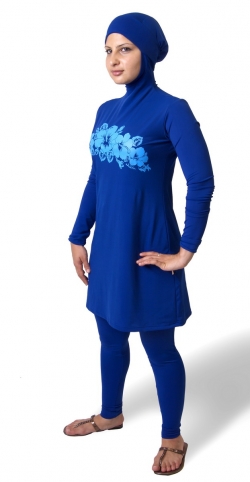
Well, it just keep floating up, and this time in the form of swimwear, although burqini also sounds like it could be a delectible virgin martini as well. Once again the setting is LA FRANCE, where a converted Frenchwoman was told she could not bathe in a full-length swimsuit designed to minimize skin exposure for Muslim women.

I remember a couple of years back finding a website selling "modesty swimsuits" to conservative christian families. The similiarities to me are quite striking.


My Two Cents on Angie Galal's "A foreign view of the 'foreign'' niqab' from the Al-Watan Daily

, , | 0 comments


The Al Watan Daily published another leg of their exploratory journey of the niqab. This time, expats were interviewed to get their opinion on their initial impressions/aprehensions of seeing women wear the niqab for the first time in Kuwait. Although most of the responses are common to many foreigners living in Kuwait, some other perspectives were excluded in this talk. There are three that stick out in my head:


1. It is very difficult for foreigners to wrap their head around the idea that the niqab is utilized as a means of achieving modesty when some of those who wear it wear obscene amounts of makeup or are more studded with bling crystals than a LITE BRITE.

2. Again, as I mentioned earlier, the irony of this article of clothing is that it provides the anonymity needed to facilitate the very activities that it aims to diminish. Many of us have been accosted by women wearing the niqab resorting to begging in the central souks, and although I have not personally, I have male friends who have been approached for prostitution by women wearing the niqab. I will not mention the school, but my parents told me about an incident of a male high schooler dressing up in the niqab and abaya in order to sneak into the ladies bathroom at a ceremonial function. The police came and everything to take him away.

3. The hardest part of actually knowing and interacting with women wearing the niqab is that it is difficult for me to deal with not being able to see their smiles. I know it sounds silly, but once I was laughing with a girl wearing it and this really struck me about the situation. On another hand, I have been approached before by people I know who wear the niqab while in the supermarkets and shopping centres. It is always these women who have to come to me to greet me, because I would not recognize them otherwise. I find it a little saddening that I could walk past someone I might know for years without turning my head. I also believe it limits what I call opportunities for improvised social interaction, which are already so limited and few here in Kuwait. A world full of people wearing the niqab would be a world of eternal strangers. I find it isolating not only to the wearer but to the observer.

But, of course, women have been wearing the niqab for centuries and have continued on, and I have lived here less than a year. Nonetheless, these are elements I grapple with when meeting people who "choose" to wear the niqab.

"The niqab, the black cloth covering the faces of women in the Middle East and particularly the Gulf region, is considered eccentric by many foreigners who come to this part of the world. Some of the foreigners residing in Kuwait try to untangle the meanings behind what is, to them, an unconventional costume, while others prefer to stay distant, believing that by doing so they are respecting the culture and religion of the country. Concluding a week long look at the niqab and other similar coverings in Kuwait, Al Watan Daily spoke to several foreigners to hear what they had to say about the traditional clothing.

Jana, a European expatriate, said that "it''s up to them if they feel ok like this. I''m asking why there are women who wear it and why there are others who do not, but I respect that they wear it."

Vicky, an American expatriate, described her initial reaction when she first came to Kuwait as "thrown back."
"I did not understand why women should not show their face. I asked and got different responses from people. Some people said it was to cover the women''s beauty, some people said it was the husband''s choice. I never really got a clear understanding of why. When you initially get here, well, you become overwhelmed because you don''t see this dress a lot in America. However, when you then see it a lot for the first few days, it becomes normal to you and just part of life. I was wondering if it was oppressive, but the women I talked to feel very comfortable wearing it. It gives you greater respect for someone else''s culture. I guess if you are ignorant and judgmental, you''ll wonder why are they doing that, but being knowledgeable, you carry what you know about the culture back home," she said.

Raquel and Lee, a married American couple, felt "intimidated" when they first came to Kuwait. "We are always trying to be respectful and keep our distance," said Raquel. You always expect that someone that traditional will not relate to us or speak English," she added.

"We had an experience a year ago because we heard a ''monaqaba'' (a woman wearing the niqab) speak perfect Californian English, and we were surprised. I guess she grew up there," said Lee, believing that the reason behind the niqab is due to cultural reasons, unlike his wife who argued that it''s religious.

"We both threw ourselves in and researched and learned and did everything we could to engross ourselves about the culture and it didn''t take us very long at all. Just a little bit of research and talking to people and we felt completely natural," he added.

"Our biggest shock, a visual parallel to us, was walking into a mall and seeing a woman fully covered in a lingerie store. And now when we go back home we''re more understanding," said Raquel." (for link, click here)

Beauty Standards and the Cosmetics Industry in the Gulf

, , , | 0 comments

The "salon" experience deserves its own sociological study in the Middle East (although the recent Lebanese movie hit Caramel introduced us to this), especially in the Gulf countries. One of the offers in many salons is to get make-up done, a process that goes far beyond (by far we are talking galaxies and parallel dimensions) Western standards of a makeoever.

I have really tried to do research on the cosmetics industry here in the Gulf to try to ascertain consumer demand but have a hard time finding studies on beauty standards, makeup aesthetics and market sector analysis.

In any case, I found a catalogue of famous makeup artists here in Kuwait. Below are some of their...creations. Yes, the first picture says "Kuwait" on the forehead. I am attempting to honor this month, as christened by Sarkozy, in the name of standards and perceptions of beauty/modesty, freedom/constraint, the secular/the religious towards Women in the Middle East.


In-Depth Report on Growing Incidence of Niqab in Kuwait Post-Invasion

, | 3 comments


The niqab is a face covering that leaves the eyes in view but leaves hidden below the nose. It is worn with the abaya and can vary in intensity. Some leave only slits for the eyes and are tied around the back (seen on many tourism refugees coming from KSA to KW), but most that I see here in Kuwait leave the forehead, eyebrows and eyes free.


Al-Watan Daily wrote a long report on peoples' perceptions of the increased use of the niqab by women in Kuwait since the invasion, mostly linking this phenomenon to greater influence and ties between in Saudi Arabia to the area.

The article, interestingly enough, touches upon some more sensitive issues of wearing the niqab and the anonymity this provides for actually conducting illegal activities-namely prostitution. I was not expecting this to be covered in the piece.

"Since the 1991 liberation of Kuwait from the Iraqi occupation force, the country has witnessed a rise in the number of women wearing ''niqab'', the cloth covering the entire face of a woman except for slits for the eyes, not to be confused with the ''burqa'', which covers the top half of the face and also is seen often.

The majority of people interviewed by Al Watan Daily to speak about the rise in women wearing the niqab in Kuwait were of the opinion that it has become a prevalent phenomena due to an increase of religion''s role in politics and society. Many also said that the relationship between Saudi Arabia and Kuwait has also witnessed stronger ties since the liberation, subsequently impacting Kuwaiti society regarding the niqab.

Sana''a, a Kuwaiti in her late 40s, told Al Watan Daily, "Women in Kuwait changed a lot after the invasion; more women are wearing the niqab than before the invasion, and I think the figure has increased by more than 40 percent. I believe this happened because the culture in Kuwait has changed into a more conservative strand, and it becomes a common thing that everyone imitates."

Ola, an Egyptian teacher, commented that women in Kuwait changed after the Gulf War in the earl 1990s "because they became more influenced by their neighboring countries, such as Saudi Arabia and Iran."

"The majority of women wearing the niqab in Kuwait are Bedouins, and they are divided into tribes, and every tribe is very religious. Nearly all the Bedouin women in these tribes wear the niqab either because they are forced to by their parents or husbands, or because it is considered a traditional practice they are used to performing and must do as part of their social obligations," she explained.

Amani, a Kuwaiti Bedouin wearing the niqab said, "In our tribe, we all have to wear the niqab; it is a practice that we have to obey. We have to follow the rules and regulations of our society. As we grow up and become more mature, we all have to wear the niqab from the age of 15, and sometime younger than that."

Tahani, a Kuwaiti woman, added, "Niqab has become very common in Kuwait as the population of the Bedouin in Kuwait increased; each family is large, with as much as eight or nine girls, and they are all told to wear the niqab."

Surprisingly, some women wear the niqab to hide from something they are doing, while others wear it to attract men with the enhanced beauty of their eyes and the mystery associated with what is underneath the garment.

Huwayda, who works in one of the ministries, commented on this issue; "Not all Muslims are good and proper Muslims, and the same thing goes for the hijab and niqab. Not every woman wearing the hijab, and especially the niqab, to cover their face are doing this for religious purposes. We all know that some prostitutes tend to cover their faces behind the niqab to be able to do what they want without revealing their identity. There are women that tend to use the niqab as a disguise to hide their improper behaviors."

Huwayda''s friend Mona noted that many women wearing the niqab put full makeup over their eyes to accentuate the beauty of their eyes, "and they think that this is the way to attract men towards them..." (for the rest of the article, please click here)